John Vincent – Air Gunner, Halifax LW280
Last Updated on 28th March 2026
FS J.K.R. Vincent – a lucky escape
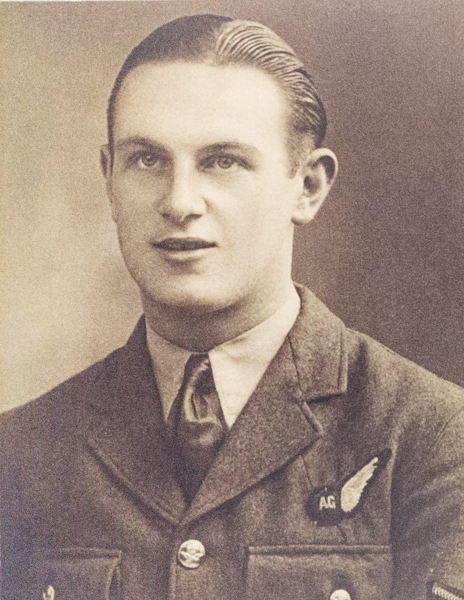
In all the histories of WWII very little mention is made of the people who supported and supplied the Resistance Agents working in occupied Europe. My Uncle, John Vincent, was one of these. As a crew member (rear gunner) he flew many times in a lone aircraft low over hostile lands dropping agents and supplies.
John Keith Robert Vincent 1336764, Royal Air Force Volunteer Reserve
John had joined up as soon as he could. Training was received in Airspeed Oxfords and Whitleys and he was trained not only in firing guns but also the use of the cine camera gun. Their first operational mission was in October 1943, listed in his log book as “Operations as Detailed (France)”. I presume that due to the nature of their operations, no further details could be included.
On 17 Dec 1943, he and the rest of the crew had had to bail out over East Anglia when upon returning from a mission (OPERATION MARC 1) they found that the entire country was fog bound. Without any visual it was hard to find anywhere to land and after flying for nearly 10 hours they ran out of fuel and had to bail out, leaving the plane to crash in mud flats near Walton-on-the-Naze. Unfortunately, 4 of the crew landed in water (near Harwich) and were drowned. The aircraft (LW280 NF-K) and crew at that time are pictured below: (JV is on the right)
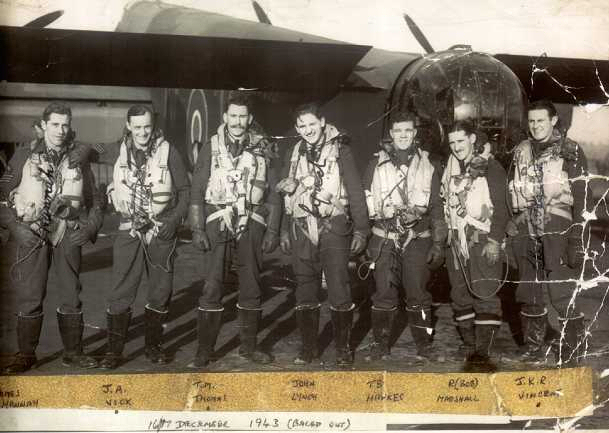
Of note: The Halifax bombers used by 138 Sqdn were modified and the mid turret removed to create more space – the full crew was kept as one “Air Gunner” was actually the despatcher, however it did leave the aircraft under armed.
Sgt James Johnstone Hannah RAFVR Wireless Op / Gunner – died buried at Cathcart Cemetery
Sgt J.A. Vick – rescued
F/Sgt T.M. Thomas – Pilot – rescued
Sgt John Lynch RAFVR – Navigator – died buried at Hamilton West Cemetery
Sgt Tom Bailey Hawkes RAFVR Flight Engineer – died buried at Luton General Cemetery
Sgt Robert Marshall RAFVR – Air Bomber – died buried at Larkhall Cemetery, Dalserf, Lanarkshire
Sgt J.K.R. Vincent – rescued
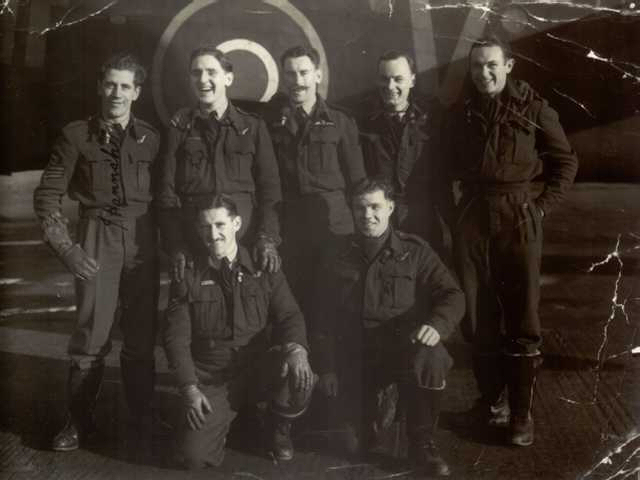
This was one of the worst nights for bomber losses during WW2 – nearly 30 were lost due to getting lost in the fog or crashing on return to base after completing their missions, in addition to 25 or so lost during a bombing raid on Berlin. SOE lone aircraft such as the one described here would complete their missions under the cover of the larger raids in the hope that they would more easily avoid detection.
For all the drama of the night, the log book entry seems quite understated after nearly 10 hours of flight (the operations in Denmark were on the 10 Dec):
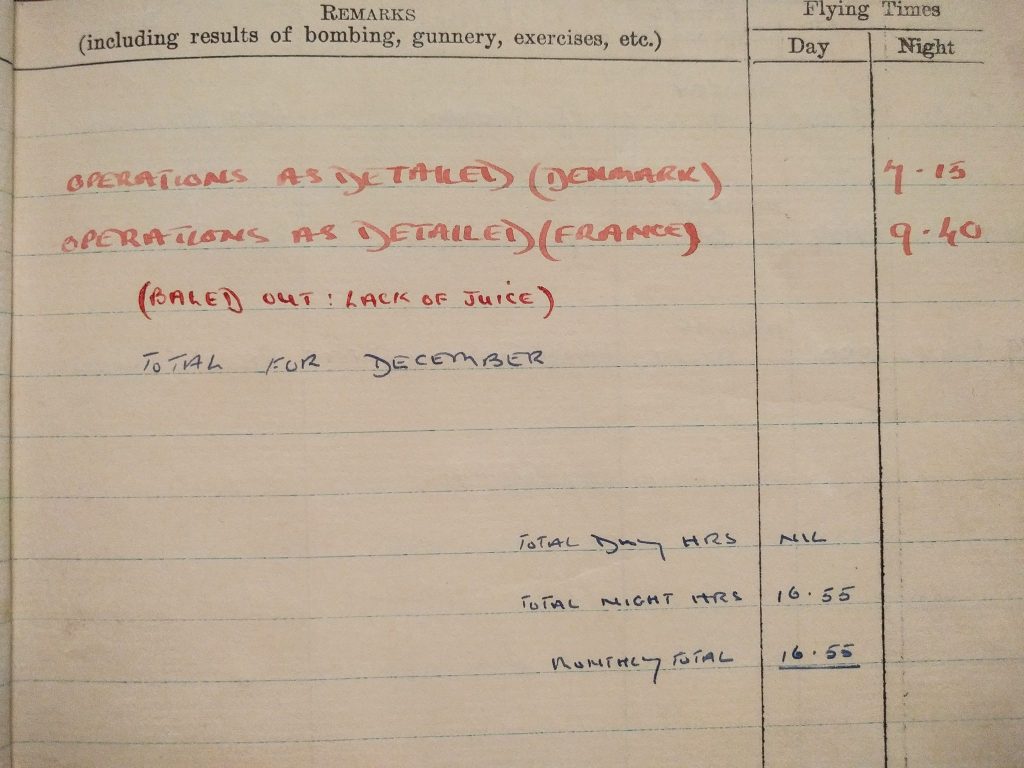
John, along with his two surviving colleagues, was allocated to another aircraft (LL307) along with new crewmates.
The report produced for Operation MARC 1 (pictured below) shows that its load carried included 3 additional personnel, 12 containers, leaflets “S-F 175”, and 4 packages.
"Target area 1 was reached but no response was obtained on either S.Phones or Rebecca. Course was set for second target and flown to on D.R., but no response was obtained on Rebecca or S.Phones. Target pinpoints were both covered in 10/10 cloud. Logs were lost with a/c, which had to be abandoned over East Anglia."
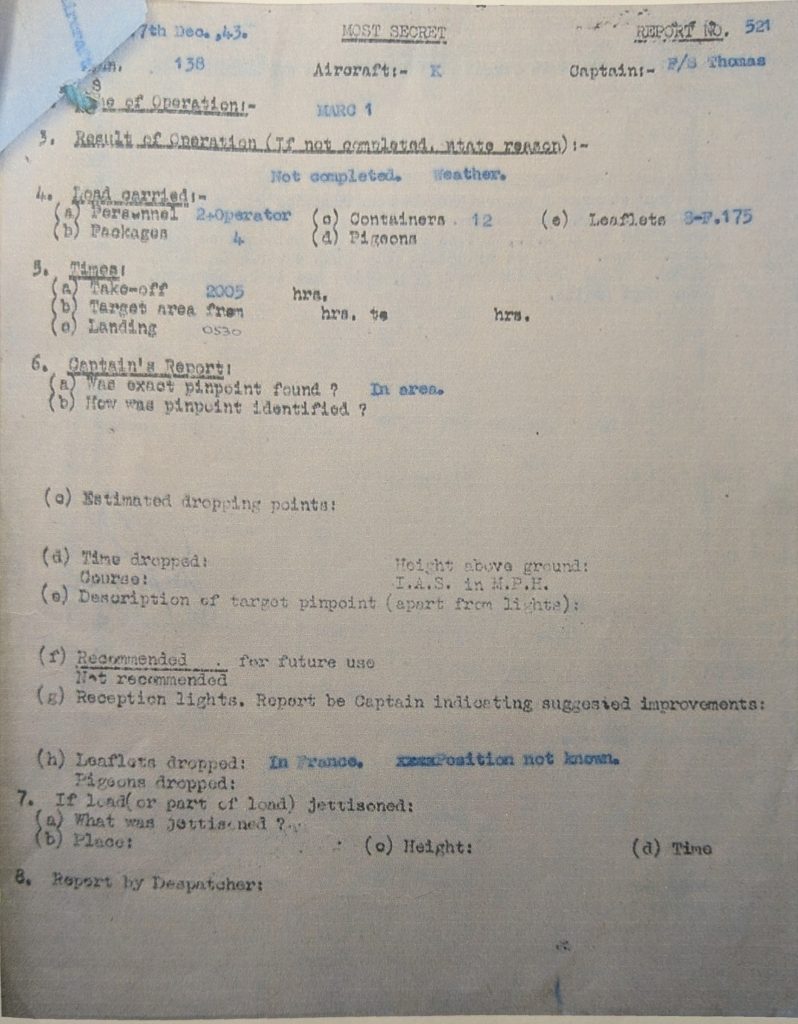
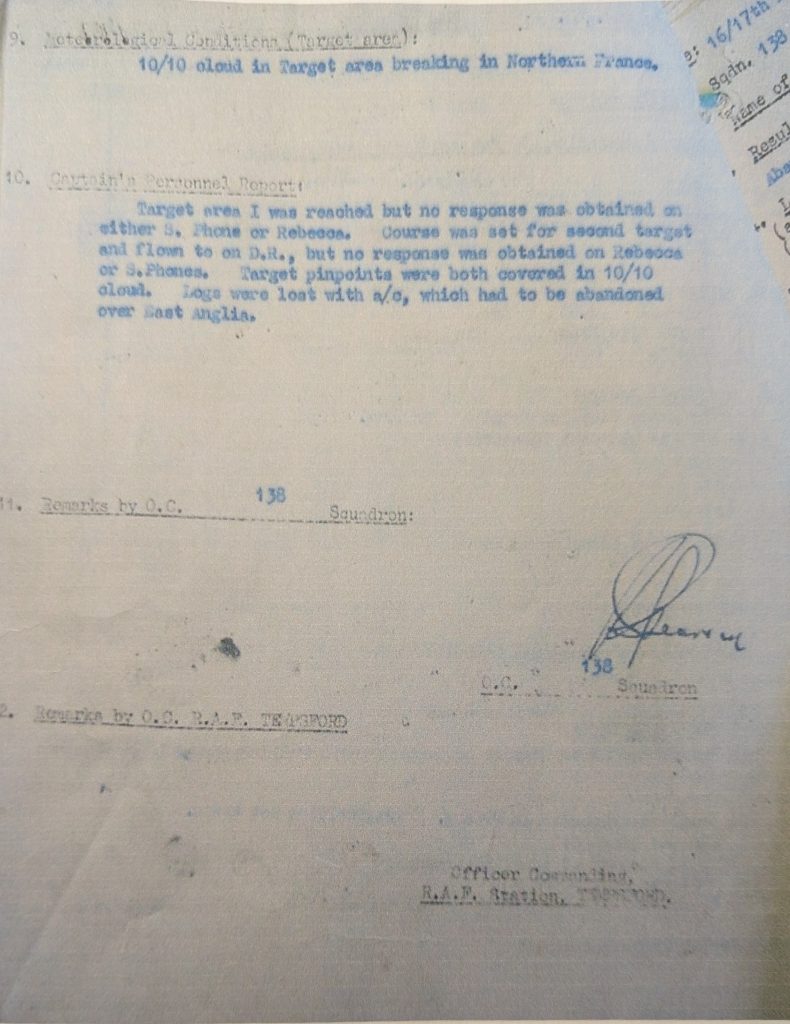
The Mersea museum contains an account of the finding of the crashed aircraft and indicates that it had been carrying agents as well as “sabotage instructions detailing how to blow up this and that printed in French”,
Unfortunately the museums findings were that one of the agents was also lost – Lieutenant (or Resistance Commandant) Henri Drouilh – but the two others must have survived. I wonder what the locals would make of two individuals dressed in civilian clothes appearing out of the sky – especially as presumably they would be carrying paperwork appropriate to the occupied area they were supposed to drop in and may not have been native english speakers. Presumably the local police would have been able to get them passed back to a suitable military organisation to confirm their validity.
Page updated 28/3/26 to include details from the operational report and findings from Mersea museum.
➡ Mersea Museum – Handley Page Halifax LW280
➡ RAF Commands – details of the crash